
ChatGPT Ads in Brazil: CTR, CPC and lessons from six weeks
Six weeks of ChatGPT Ads in Brazil. Account setup, tracking, campaign structure and real CTR, CPC and CPM numbers, with the drop that followed a strong start.


ChatGPT started showing ads in Brazil in August 2026, and since the first week we have had campaigns running in some of the accounts Marktech manages. This article sums up what it took to open the account, set up tracking and build a campaign, and shares the CTR, CPC and CPM numbers from these first six weeks, including the drop in results that followed a very strong start.
OpenAI tested ads with Brazilian users in the first week of August and confirmed the launch on the 11th. Two days later our first campaign was running. The data runs through September 22, combines all the accounts and identifies none of them.
- Where does the ad appear and who sees it?
- How do you open the account and set up tracking?
- How do you build the campaign?
- CTR, CPC and CPM in the first weeks
- What happened week by week
- The algorithm would rather spend
- Does your audience use ChatGPT as a search engine?
- Where to start
Where does the ad appear and who sees it?
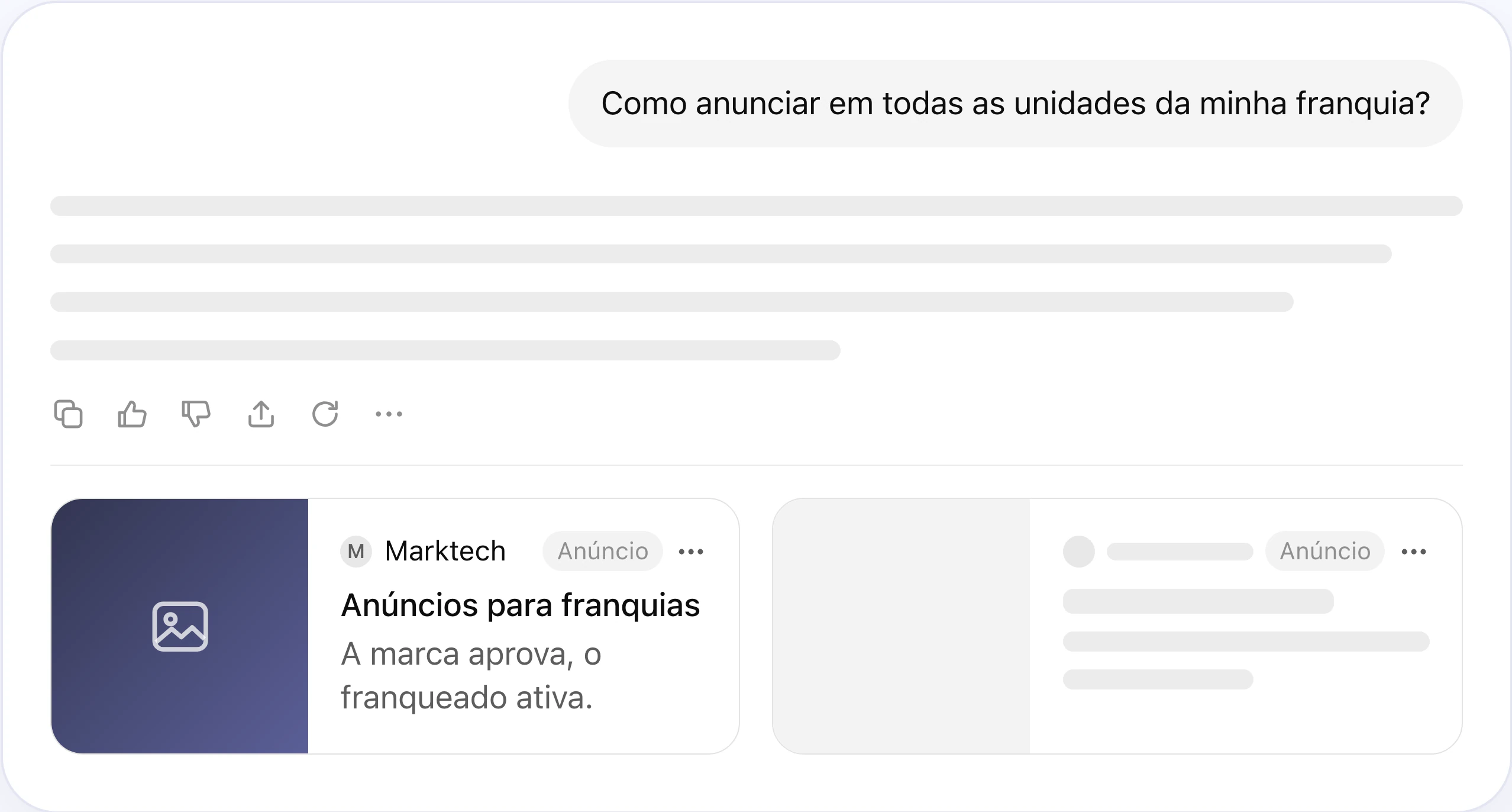
The ad is a card below the ChatGPT answer, set apart by a thin line and labeled “Ad”. It carries the advertiser's name and favicon, a headline, a short description, a square image and the destination link. On desktop, when more than one ad is relevant to the conversation, two cards share the same row. The answer itself does not change because of the ad; OpenAI treats that separation as a principle of the program.
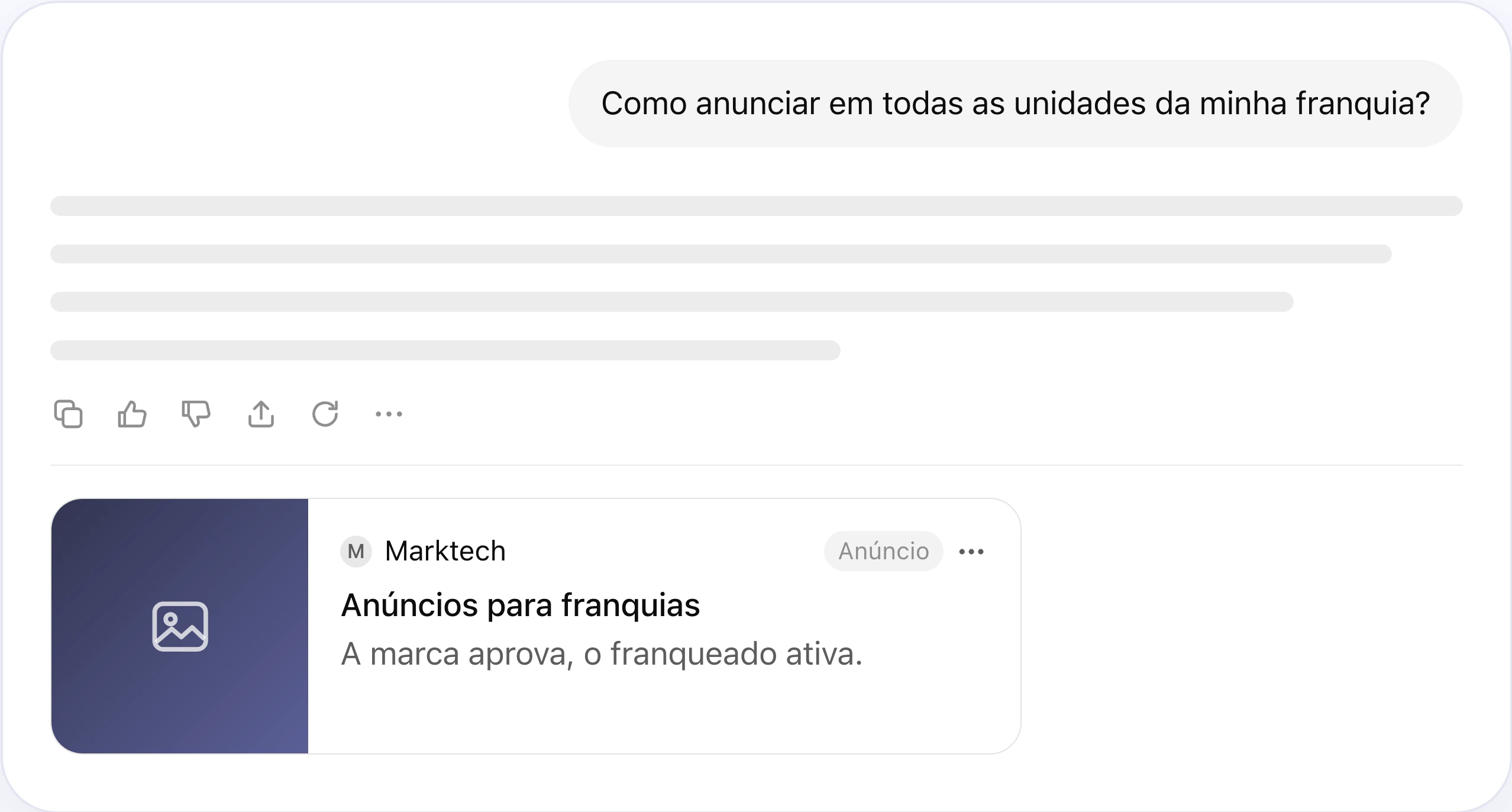
Not everyone sees the cards. They only show to users 18 and over on the Free and Go plans; anyone paying for Plus, Pro or a business plan gets no ads, and sensitive topics, such as health and politics, are left out. As OpenAI told the press, ads only enter conversations with commercial intent, close to a fifth of all queries. Which ad gets chosen depends on the topic of the conversation, the ads the person has already interacted with and, with personalization turned on, their ChatGPT history. The advertiser only sees totals for impressions, clicks and conversions.
How do you open the account and set up tracking?
The account starts at ads.openai.com with a regular OpenAI login. Sign-up asks for company details, country, currency and time zone (those three cannot be changed later), goes through identity verification with Persona and then waits a few days in the review queue. After that you still need the name and favicon that appear on the card, a billing profile with the company tax ID and a credit card. Billing is postpaid, charged when spend hits a threshold or at month end. You can even create and edit campaigns from inside ChatGPT.
Tracking practically mirrors Meta Ads, right down to the names, and not by accident. There is a Pixel for the site (directly or through Google Tag Manager), a Conversions API on the server, automatic advanced matching and an event quality score. The two differences that matter are oppref, a parameter that arrives with the click and has to survive redirects, and the fact that only standard events (lead, sign-up, order created) can be used to optimize delivery. Conversions show up with a delay of up to 48 hours, and our UTM convention is utm_source openai with utm_medium cpc; the UTM builder suggests chatgpt as the source, and either works as long as the account does not mix them.
How do you build the campaign?
Ads Manager is very similar to Meta's, structure included. The campaign sets the objective, budget, dates, locations and platforms; the ad group sets the bid and the theme; the ad is the card. The objectives are views (charged per thousand impressions), clicks and conversions; the last one optimizes for a standard event and charges per click or per impression. Objective, billing method and event cannot be changed once created, so a change of direction means a new campaign. The minimum budget is R$ 40 per day, treated as a weekly average, and a single day can spend up to twice that.

Targeting is where it differs most. There are no keywords, age, gender or interests. The campaign picks the country (in Brazil, states and cities as well), the platforms (app and web on iOS and Android, and web on desktop) and custom audiences built from emails or phone numbers, with a minimum of 25,000 matched people to be included. Everything else lives in the ad group's context hints, a free-text field describing which conversations and needs the product is relevant to. The documentation asks for natural sentences about what it is, who it is for and when it helps, and warns that the hint guides relevance but is not a display rule. We tested two approaches, listing questions the way a user would ask them and describing the audience and intent in prose, with what to prioritize and what to avoid, and both deliver. Bidding has two options, Maximize results (the default) and a manual max bid, and conversion campaigns add a bid cap on the cost per conversion. That was the most important decision of these weeks, and we come back to it further down.
The ad inherits the account's name and favicon and has a headline of up to 50 characters, a description of up to 100, a square image and a link. On screen it is small and long text will not be read, so it pays to stay within what OpenAI recommends, 16 to 24 characters for the headline and 32 to 48 for the description; anything beyond that tends to get cut off, especially on mobile. The guidance is to have several variations per group, each with its own angle, so the system can find more conversations where the ad fits, and everything goes through review. If you are unsure how the ad will look, the preview tool below shows it.
CTR, CPC and CPM in the first weeks
The numbers below combine every campaign between August 13 and September 22, 2026, calculated from the period totals (clicks divided by impressions, spend divided by clicks), as in our Google Ads benchmark.
| Impressions | Clicks | CTR | CPC | CPM |
|---|---|---|---|---|
| 4,965,784 | 66,229 | 1.33% | R$ 2.40 | R$ 32.05 |
For comparison, the median across the Google Search accounts we manage stood in July at a CTR of 8.98%, a CPC of R$ 2.52 and a CPM of R$ 248.51. On ChatGPT a click costs about the same, but an impression costs an eighth as much, because only one in every 75 turns into a click. In CTR and CPM, the channel looks like the Meta feed, not search. CPM stayed between R$ 32 and R$ 36 across accounts with very different segments and budgets, which suggests the auction prices an impression in much the same way everywhere and each ad's CTR is what decides the CPC.
What happened week by week
The first week was the best we have seen on the channel. A click cost R$ 1.03 and the cost per result was below what the same accounts were paying on search and on social. On that signal, the daily budget was raised more than sixfold the following week, and results got worse right after.
| Week | Daily budget (index) | CTR | CPC |
|---|---|---|---|
| 1 | 100 | 1.80% | R$ 1.03 |
| 2 | 662 | 1.27% | R$ 1.92 |
| 3 | 590 | 1.31% | R$ 2.90 |
| 4 | 470 | 1.18% | R$ 4.09 |
| 5 | 193 | 1.45% | R$ 2.46 |
| 6* | 120 | 1.51% | R$ 2.49 |

Conversions went the same way. From the first week to the fourth, the conversion rate fell 88% and the cost per conversion rose 3,266%; by week six, with the budget back near the start, the rate was still 78% below week one and the cost per conversion 1,007% above it.
Part of the explanation is on us. Multiplying the budget within the same audience means buying that audience's most expensive impressions, and every extra R$ 1 spent brings back less than the one before, the concave curve from our article on splitting budget across channels. The other part is the market. The channel opened with few advertisers competing for the same conversations, and a second-price auction with little competition is a cheap auction; as other advertisers come in, the second price rises, as in the Google Ads auction. The clue is in the last two weeks, when the budget came down and CPC settled around R$ 2.50, 2.4 times the opening price.
The algorithm would rather spend
A falling conversion rate while volume climbs is the signature of an audience that has expanded. The campaigns ran on the default strategy, Maximize results, with no bid cap. The documentation warns that the strategy goes after the largest number of results within the budget and does not guarantee a cost per result. When the budget grows faster than the truly relevant conversations, the system stretches delivery into less relevant conversations until it manages to spend, and pays more for them. The targeting looked reasonable to us and lead quality was acceptable. What got out of hand was how much the algorithm was willing to pay to widen the audience.
The first fix was to bring the budget back to its initial level. The second, which we recommend to anyone starting out, is not to leave the bid unconstrained, with a manual max bid in groups that already have history or a bid cap in conversion campaigns. OpenAI suggests a max bid between $3 and $5 per click in click campaigns; for conversions there is no official suggestion, and the cap has to come from the cost per lead the operation can sustain. And it pays to look at the conversion rate by week, because the cumulative figure hides the drop.
Does your audience use ChatGPT as a search engine?
The channel's biggest limitation is usage habits. The ad only appears to people who use ChatGPT, and the habit of turning to AI assistants for everyday searches has been adopted unevenly. It is fair to expect a student to open ChatGPT many more times a day than the owner of a bakery, on average, and that gap defines how much of your audience the channel can reach; in our accounts, the available volume varied a lot from one segment to another. On top of that, the professional who pays for Plus or uses a business plan, often the decision-maker a B2B campaign is after, sits outside the inventory.
And part of conversational search does not even happen on ChatGPT. Plenty of people ask Google itself, which answers with AI right on the results page, or the assistants built into WhatsApp and the browser. ChatGPT Ads buys a slice of that behavior, not the whole of it. To find out whether your audience is there, the path is the usual one, a small campaign, with conversions properly measured, compared against the ones already running.
Where to start
- Tracking before the campaign. Pixel and Conversions API, a standard event chosen, oppref preserved through redirects and UTMs following the account's convention;
- A small budget for longer. A conversion campaign near the minimum, with a bid cap from day one, and a weekly read of CPC and conversion rate;
- Context hints written as statements of need. What the product is, who it is for and in which situation it helps, with separate groups per intent;
- Several ads per group. Headlines of 16 to 24 characters and descriptions of 32 to 48, each with its own angle, and the most specific page possible as the destination;
- Your own yardstick. The first week's numbers are not the channel's yardstick; the fair comparison is with the cost per result of the other channels in the same account, after a month.
We will come back to this with more weeks of data. For now, it is worth testing with a small budget and being wary of results that look too good at the start, because the auction is still filling up.
Want these results in your campaigns?
Talk to a Marktech consultant and get a free diagnosis of your media operation.
Talk to a consultant